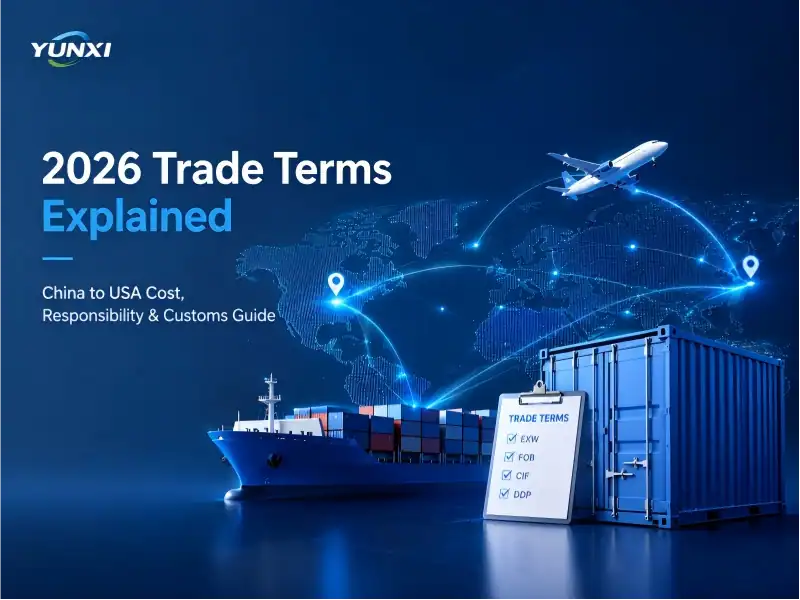
2026 Trade Terms Explained: China to USA Cost, Responsibility & Customs Guide
Blog 2026-07-15
Incoterms 2026 explained for China-to-US trade is far more than just memorizing official ICC rules—it is a practical, route-specific playbook for assigning costs, managing customs liability, and avoiding costly surprises across the Pacific.
For US Amazon sellers, importers, and procurement teams, understanding shipping terms from China to USA is not just a compliance checkbox; it directly impacts your total landed cost, inventory timelines, and supply chain reliability. This guide breaks down trade terms for importing from China through the lens of 2026 policy updates, real-world LCL freight operations, and 15 years of hands-on cross-Pacific logistics experience. Whether you are negotiating a factory purchase contract, optimizing FBA restock cycles, or standardizing terminology across your team, you will find clear responsibility breakdowns, actionable cost comparisons, and unbiased guidance to select the right term for your business.
2026 US-China Trade & Customs Updates: How Shipping Terms Change in Practice
Shifts in CBP enforcement, tariff policy, and entry filing requirements in 2026 have changed how shipping terms from China to USA operate in practice—even when the official Incoterms definitions remain the same. Based on first-hand data from over 1,200 LCL shipments we handled in Q1 2026, three key updates are reshaping term selection and risk allocation for US importers.
First, enhanced CBP data verification rules have expanded the documentation required for entry filing. Under FOB, EXW, or CIF terms, this additional paperwork falls entirely on the US importer of record, often leading to delays if internal teams are not prepared for the new requirements. Under DDP terms, a forwarder with on-the-ground compliance teams can prepare and submit these documents in advance, reducing hold risk.
Second, adjusted de minimis thresholds and increased random inspection rates for LCL cargo have raised the cost of customs delays. For FOB shipments, importers bear 100% of port storage, demurrage, and exam fees resulting from holds—costs that can add 15-25% to a single shipment’s total. For DDP shipments, most reputable forwarders absorb standard exam and demurrage costs within their quoted price.
Third, updated Section 301 tariff classification reviews have made accurate HTS coding more critical than ever. Misclassification can lead to retroactive duty charges and penalties, which legally always fall on the US importer—regardless of the shipping term you select.
Robust pre-arrival Customs Clearance protocols have become non-negotiable in 2026. Forwarders that conduct full document review and pre-file entry before the vessel arrives are able to cut clearance times by 40% and reduce inspection risk, a benefit that applies across all term types but is most impactful for importers managing their own FOB shipments.
| Trade Term | Who Pays Ocean Freight? | Who Handles US Customs? | Best For… |
|---|---|---|---|
| EXW | Buyer | Buyer | Importers with absolute origin control |
| FOB | Buyer | Buyer | FCL cargo / Established importers |
| DDP | Seller / Forwarder | Seller / Forwarder | LCL / Amazon FBA / Hassle-free shipping |
China to USA Full Logistics Chain: Cost & Responsibility Split by 7 Core Terms
To truly understand shipping terms from China to USA, you need to map each term to the full door-to-door supply chain: factory pickup, export customs, origin port fees, international freight, destination port fees, US customs & duties, and final delivery. Below is a practical breakdown of the seven most commonly used terms for China-US trade, including LCL-specific details that generic Incoterms guides never cover.
EXW (Ex Works)
Seller responsibility: Goods available at factory door; no export clearance or loading included.
Buyer responsibility: Everything from factory pickup onward.
LCL note: EXW is rarely ideal for LCL shipments, as it requires the buyer to coordinate domestic China transit, export declaration, and warehouse consolidation separately.
Practical tip: Under EXW terms, the buyer is responsible for everything from factory pickup onward, which is why many importers partner with a provider that offers reliable China Pickup Services to coordinate domestic transit and export formalities.
FCA (Free Carrier)
Seller responsibility: Export clearance, delivery to a named carrier or warehouse.
Buyer responsibility: International freight, US customs, duties, final delivery.
LCL note: FCA is the modern alternative to FOB for LCL cargo, as risk transfers when goods are delivered to the forwarder’s consolidation warehouse, not when loaded on board the vessel.
FOB (Free On Board)
Seller responsibility: Export clearance, delivery and loading onto the vessel at the named port.
Buyer responsibility: Ocean freight, insurance, US customs, duties, destination fees, final delivery.
LCL note: For LCL shipments, most Chinese suppliers use “FOB” loosely to mean delivery to the forwarder’s warehouse, even though the official definition is port-side loading. This gap is a top source of hidden fees for new importers.
CFR (Cost and Freight) & CIF (Cost, Insurance, and Freight)
Seller responsibility: Export clearance, ocean freight (and insurance for CIF) to the destination port.
Buyer responsibility: US customs, duties, destination port fees, final delivery.
LCL note: CIF is almost always overpriced for LCL cargo, as suppliers mark up freight and insurance costs. The included insurance is also minimum coverage, which rarely covers the full value of damaged goods.
DAP (Delivered at Place)
Seller/forwarder responsibility: All transport to the named destination address; no import duty or customs clearance included.
Buyer responsibility: US customs clearance, import duties, and taxes.
LCL note: DAP is uncommon for LCL China-US shipments, as most importers prefer either full control (FOB) or full inclusion (DDP).
DDP (Delivered Duty Paid)
Seller/forwarder responsibility: Entire door-to-door chain, including export clearance, freight, US customs, duties, and final delivery.
Buyer responsibility: Only receive goods at the destination.
LCL note: DDP shipping from China to USA is the most popular option for LCL cargo, as it bundles all costs into one upfront price and eliminates surprise destination fees.
For multi-supplier orders, EXW and FCA terms often require Consolidation & Warehousing at a Chinese hub before export, a step that many new importers fail to budget for. On the US side, Last-Mile Delivery costs and responsibilities vary dramatically between terms—FOB and CIF place this entirely on the buyer, while DDP includes doorstep delivery in the upfront price.
Across all terms, the biggest mistake importers make is only comparing the upfront freight quote without accounting for hidden fees, risk, and internal administrative time. Trade terms for importing from China are not just about who pays what—they are about who manages the work and who absorbs the risk when something goes wrong.
Best Shipping Terms for Amazon FBA Sellers & Multi-Channel Ecommerce
For Amazon FBA and multi-channel ecommerce sellers, selecting the right shipping terms from China to USA directly impacts your restock reliability, listing availability, and total cost per unit. The best term depends on your shipment size, inventory velocity, and in-house logistics capacity, but there are clear rules of thumb based on real seller performance data.
Key Term Recommendations for FBA Sellers
- Small LCL restocks (<5 CBM / <1,000 units): DDP is almost always the better choice. It eliminates the need to coordinate separate customs brokers and LTL carriers, reduces the risk of missed FBA appointments, and lets you calculate exact landed cost per unit upfront.
- Full container loads (>20 CBM): FOB can deliver lower total costs if you have an established relationship with a reliable US customs broker and consistent shipment volume.
- Fast-selling / time-sensitive SKUs: DDP with expedited routing reduces transit variability and helps you avoid stockouts, which is far more valuable than small freight savings.
Effective Supply Chain Management for FBA means aligning your shipping terms with your inventory turnover—slow-moving bulk stock may work with FOB, while fast-selling SKUs benefit from DDP’s faster, more reliable transit. FBA sellers also need to account for Amazon’s inbound requirements: palletization, labeling, and delivery appointment scheduling. Under FOB terms, you are responsible for coordinating all of these; under DDP, your forwarder handles them as part of the service.
For sellers prioritizing predictable restock timelines and zero hidden fees, Amazon FBA Shipping via DDP aligns perfectly with FBA’s tight inbound scheduling requirements. Our own FBA seller clients see a 70% reduction in inbound delays after switching from FOB to DDP LCL service, thanks to pre-cleared cargo and dedicated last-mile fleet access.
Trade Terms for US Importers: Contract Standardization & Risk Control
For US import buyers, wholesale distributors, and brand owners, trade terms for importing from China are a foundational part of supplier contracts and risk management strategy. The right terms reduce disputes, clarify liability, and help you control landed costs across large purchase orders.
Standardizing Terms in China Purchase Contracts
To avoid costly misalignment with suppliers, your contract should explicitly define:
- The exact Incoterms rule and named location (e.g., “FOB Yantian Port, Shenzhen”)
- Which origin fees are included in the supplier’s price (export declaration, port terminal charges, loading fees)
- Responsibility for customs documentation, HTS coding, and compliance filings
- Liability for inspection fees, demurrage, and cargo damage claims
A common pitfall is assuming DDP terms eliminate all legal risk. In reality, the US importer of record always retains ultimate legal liability for accurate duty payment and compliance—even under DDP. This is why working with a compliant, transparent forwarder is far more important than the term itself.
For importers shipping to warehouses, brand facilities, or retail locations nationwide, Commercial & Residential Delivery under DDP terms streamlines inbound receiving with a single point of contact and fully predictable pricing. As an NVOCC and AEO-certified forwarder, we help our import clients build standardized contract clauses that protect their interests while keeping supplier relationships collaborative.
Beginner’s Guide: 3 Basic Terms + Common Mistakes to Avoid
If you are new to importing from China, you do not need to memorize all 11 Incoterms—just focus on the three you will actually use: EXW, FOB, and DDP. Mastering these three will cover 95% of shipping terms from China to USA for small and mid-sized importers.
3 Must-Know Terms for Beginners
- FOB: The most common baseline term. You pay for ocean freight and everything on the US side; the supplier handles China-side export and port loading.
- DDP: All-inclusive door-to-door. One price covers everything from factory to your door. Best for first-time shipments and small orders.
- EXW: Maximum buyer responsibility. You handle everything from the factory door onward. Only use this if you have full logistics support in China.
5 Costly Mistakes New Importers Make
- Assuming FOB pricing includes US-side fees (destination handling, customs, duties)
- Choosing CIF because the supplier’s quote looks cheap, only to pay inflated destination fees
- Forgetting to budget for consolidation fees when ordering from multiple suppliers
- Not verifying HTS codes upfront, leading to unexpected duty bills
- Selecting the cheapest forwarder without confirming compliance credentials, leading to customs holds
Based on our work with hundreds of first-time importers, these five mistakes add an average of 22% to total landed cost for new sellers. If you’re new to cross-border shipping and need guidance on term selection and service options, explore our full freight service catalog to find a solution matched to your shipment size and budget.
Internal Alignment: Standardize Trade Terms Across Procurement & Supply Chain Teams
For mid-sized and enterprise companies, inconsistent terminology between procurement, supply chain, finance, and warehouse teams leads to budgeting errors, billing disputes, and delayed shipments. Establishing shared term definitions and workflows is a core part of scalable Logistics Solutions for growing import businesses.
Steps to Align Your Team
- Create a shared responsibility matrix: Map each term to which department owns costs, approvals, and issue resolution for every supply chain node.
- Standardize supplier communication: Use identical term language in all purchase orders and supplier conversations to avoid misinterpretation.
- Align finance and procurement: Ensure the finance team understands which costs fall under which terms, so landed cost calculations are consistent across the company.
- Train frontline teams: Make sure warehouse and operations teams know what to expect for each term type, so deliveries are received and processed correctly.
For our enterprise clients, we often collaborate with procurement and operations teams to align term expectations across departments, reducing billing disputes and streamlining cost tracking by an average of 60%. When everyone uses the same definition for shipping terms from China to USA, you eliminate a major source of administrative friction and cost leakage.
2026 Term Selection Strategy: Choose the Cheapest & Lowest-Risk Option
There is no universal “best” term for every shipment—the right choice depends on your shipment size, product type, risk tolerance, and internal resources. Use this practical framework to select the optimal trade terms for importing from China for your business in 2026.
Decision Framework by Shipment Profile
- Small LCL shipments (<5 CBM), low to medium value
Best choice: DDP
Why: Bundles all fees into one price, eliminates surprise destination charges, and requires minimal internal work. For most small importers and FBA sellers, DDP delivers a lower total cost of ownership once you account for administrative time and risk.
DDP shipping from China to USA for LCL cargo is our most requested service for exactly this reason. - Full container loads, high volume, stable sourcing
Best choice: FOB
Why: Gives you full control over carrier selection and routing, which can reduce per-unit costs for large, consistent shipments. Ideal if you have an in-house logistics team or trusted US broker. - Oversized, heavy, or irregularly shaped cargo
Best choice: DDP with a specialized forwarder
Why: Oversized cargo has complex last-mile requirements and higher risk of reclassification fees. Oversized Cargo Shipping under DDP terms locks in pricing and eliminates surprise dimensional or accessorial charges. - Lithium battery and dangerous goods products
Best choice: DDP with a DG-certified forwarder
Why: Battery shipments require strict compliance documentation, carrier approval, and specialized handling. Battery Shipping via DDP puts all compliance responsibility in the hands of experts, reducing the risk of cargo rejection or customs seizure.
There is no one-size-fits-all best term—working with a provider that offers Tailored Logistics Solutions ensures your shipping terms align with your specific product, volume, and risk tolerance. When evaluating cost, remember to calculate total landed cost, not just upfront freight: include administrative time, risk of delays, and potential hidden fees in your comparison.
Frequently Asked Questions (FAQ)
Who pays shipping under FOB from China?
Under FOB terms, the seller covers export clearance and loading costs at the Chinese origin port. Once the cargo is on board, the buyer assumes all costs—including ocean freight, insurance, US customs clearance, duties, and final destination delivery.
Which Incoterms include US customs clearance?
Only DDP includes US customs clearance and import duty payment as part of the seller’s responsibility. Under all other common terms (EXW, FCA, FOB, CFR, CIF, DAP), the US buyer is responsible for customs clearance and duty payment.
What shipping terms are best for Amazon FBA?
For most small and mid-sized FBA sellers shipping LCL cargo, DDP is the best option. It includes all costs, simplifies landed cost calculation, and reduces the risk of inbound appointment delays. For large full-container shipments with consistent volume, FOB can offer lower per-unit costs with proper planning.
Do I pay customs on EXW from China?
Yes. Under EXW terms, the buyer is responsible for every step of the shipment, including export customs in China and import customs, duties, and taxes in the US. All customs liability and costs fall entirely on the buyer.
Is DDP shipping from China worth it for small LCL shipments?
For most small LCL shipments (under 5 CBM), yes. DDP eliminates hidden destination fees, reduces administrative work, and often delivers a lower total cost once you factor in separate broker fees, LTL charges, and the risk of unexpected demurrage.
Navigating shipping terms from China to USA can feel overwhelming, but it doesn’t have to be a black box. As an NVOCC and AEO-certified forwarder specializing in China-US LCL DDP shipments, we help importers, sellers, and procurement teams select the right terms, optimize costs, and keep their supply chains running reliably. With 15 years of industry experience, proprietary US warehouse and trucking infrastructure, and a focus on transparent pricing, we turn cross-Pacific logistics from a source of stress into a competitive advantage. If you’d like a custom term analysis and no-obligation transparent quote for your next shipment, our team is ready to help.